


A Star Is Reborn: The New Suites at Sofitel London St James
In a city where heritage hotels compete to outdo one another with heritage alone, something rarer has happened on Pall Mall: reinvention with flair. The grand neoclassical façade of Sofitel London St James now conceals a new design story, one that channels the audacity of the 1970s through a distinctly Parisian lens.
The transformation culminates in the debut of two flagship suites – Suite 70 and the Opera Suite – designed by celebrated Parisian interior architect Pierre‑Yves Rochon. Together, they complete the hotel’s multi-phase redesign, elevating the property to the upper echelon of London’s design-led luxury addresses. Think less polite refurbishment, more stylish cultural revival.

The inspiration is the creative electricity of the 1970s, when London’s music, theatre and graphic culture collided with exuberant style. In the hands of Rochon, whose portfolio includes icons like the Four Seasons Hotel George V and the Waldorf Astoria New York, that era is interpreted not as nostalgia but as theatre.
Four newly refreshed Prestige Suites set the tone, but the real show begins with the hotel’s two headline acts.
Suite 70: Backstage Glamour
Suite 70 is the design equivalent of a perfectly mixed vinyl record: rich, textured and unmistakably analogue in spirit. The palette, burnt orange, deep green, chocolate brown, punctuated with black and white, nods to the decade’s graphic boldness and the warm glow of stage lights behind velvet curtains.
Furniture by the legendary French designer Pierre Paulin anchors the space. At the same time, bespoke carpets from Edition 169 and bathroom pieces created with the British design house Devon & Devon add tactile depth.
Then there is the suite’s centrepiece: an “Experience Bar” styled like a glamorous concert trunk. Open its doors, and you’ll find vinyl records lining the interior, a vintage-style record player ready to spin them, and even a saxophone resting nearby, just in case the evening becomes particularly spirited.
The Opera Suite: A Softer Seventies
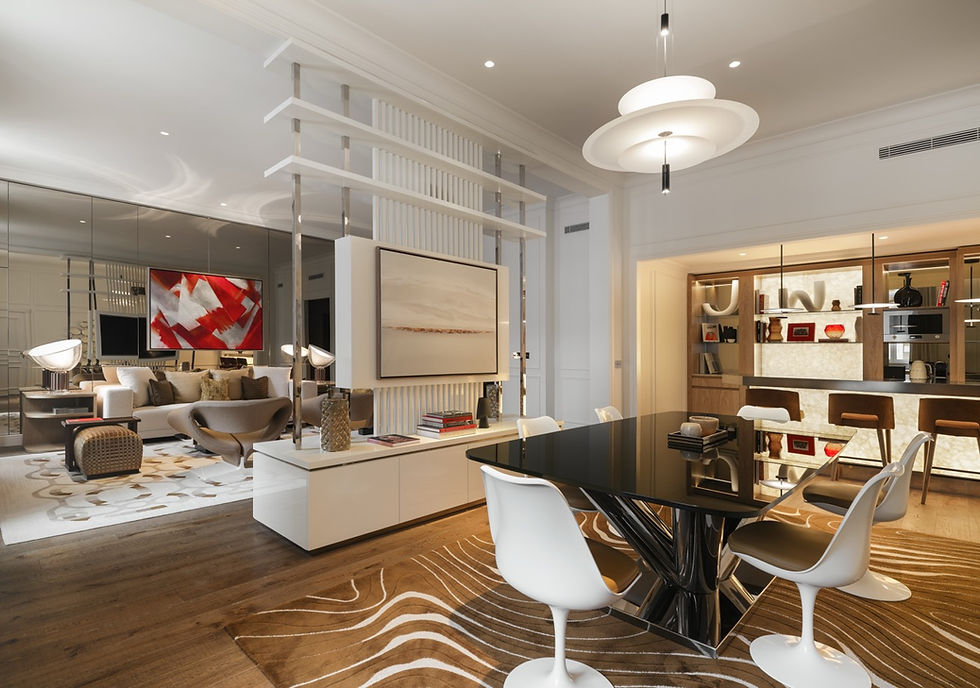
If Suite 70 captures the backstage buzz, the Opera Suite, spanning a generous 109 square metres, delivers the after-party calm. Overlooking the elegance of Waterloo Place, the suite is conceived as a residential sanctuary in the heart of St James’s.
Here, the seventies aesthetic softens into a refined palette of nude, pale pink, taupe, camel and ivory, with flashes of red for drama. The atmosphere is cocooning, elegant, and quietly seductive, like slipping into a silk robe after a long evening at the theatre.
A spectacular pale-pink suede headboard serves as the suite’s sculptural focal point, its shape inspired by the decade's graphic curves. Elsewhere, a graceful Tulip chair by Eero Saarinen, produced by Knoll, joins armchairs by Paulin, blending mid-century design icons with bespoke contemporary pieces created exclusively for the space.
The result feels less like a hotel room and more like the private apartment of a very stylish collector.
Both suites feature curated art collections selected by the consultancy VISTO, weaving together works by emerging and established artists. The pieces reflect London’s creative pulse during the 1970s while subtly referencing the hotel’s French heritage, a visual conversation between two cultural capitals.
It’s precisely this Franco-British dialogue that defines the property. From the Diptyque amenities to the hotel’s signature Sofitel MY BED, every detail balances French art de vivre with London sophistication.
Of course, a suite here comes with the full privileges of the house: Michelin-starred dining at Wild Honey St James, cocktails in the glamorous St James Bar, and afternoon tea beneath the chandeliers of the Rose Lounge.
Rates begin at £2,100 per night, a price that, in London’s luxury-hotel universe, sits comfortably in the “worth it for the design alone” category.
What the new suites ultimately achieve is rare: they make a historic hotel feel exciting again. The building’s Edwardian grandeur remains intact, but inside, there is a fresh sense of playfulness, bold, tactile, and a little bit rebellious. Just like the 1970s themselves. And, frankly, London could always use another encore.


Comments